
Sizing
What Size Dumpster Do I Need? An Honest Local Guide
Most guides ask you to estimate cubic yards. We ask three questions, and one of them is whether there is soil in it.
Start with the material, not the number
Almost nobody can estimate their own debris in cubic yards, and guides that ask you to are not much help. We ask three things instead: what are you throwing out, roughly how much in terms you can picture, and where will the container sit.
Ninety seconds on the phone beats any online calculator, because the answer here often turns on something a calculator never asks - whether it is an 1890s village house or a 2015 subdivision build, and whether there is soil in the load.
Volume and weight, and which binds first
Every container has two limits and you will hit one first. Volume is obvious - you cannot load above the top rail. Weight is the one people forget and the one that costs money.
Each size includes a tonnage allowance: roughly one to two tons on a 10 yard, four to five on a 30. Past that you pay a per-ton overage, which we quote before you book.
What each size really holds
10 yard — 12 ft × 8 ft × 3.5 ft
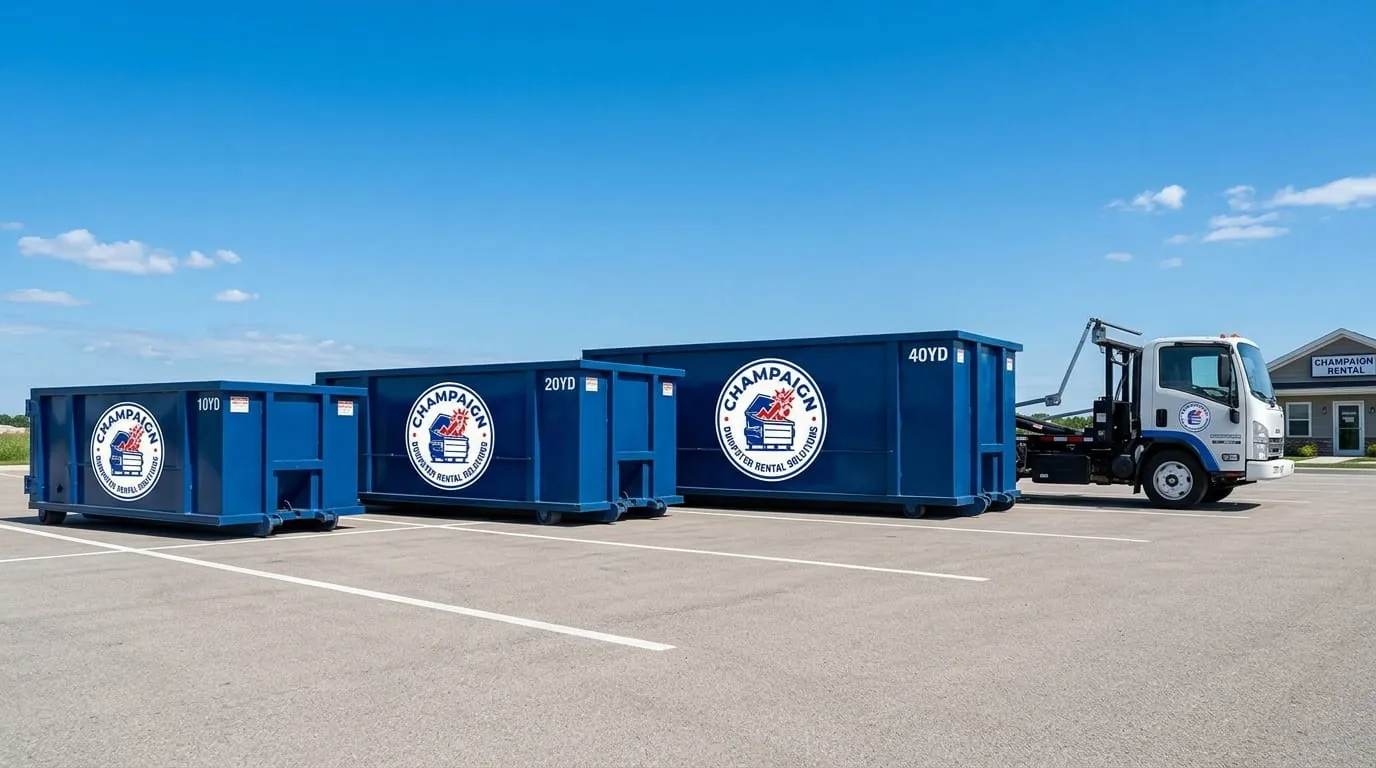
Three to four pickup loads, one to two tons. The small-job container and the heavy material container: concrete, brick, block, tile, mortar, soil and rock. Low sides mean you can throw material over the wall without a ramp.
15 yard — 16 ft × 8 ft × 4 ft
Five to six pickup loads, two to three tons. The under-used size, and the right answer more often than people think - old village cores where the driveways are short, campus-edge properties where access is tight, and any job heavy enough that a 20 would hit its weight limit half full.
20 yard — 22 ft × 8 ft × 4.5 ft
Seven to eight pickup loads, three to four tons. Our most common residential container and the default across the newer subdivisions in Savoy, Mahomet and the south of Champaign, where driveways are generous and flat.
30 yard — 22 ft × 8 ft × 6 ft
Ten to twelve pickup loads, four to five tons. Same footprint as the 20 with eighteen more inches of height, so it holds half again as much without needing more driveway. The right call for a whole-house clear-out, a multi-unit turnover, a big basement or a job site.
Worked examples from local jobs
| Job | Size | Why |
|---|---|---|
| Bathroom renovation | 10 yard | Small volume; tile and cast iron are dense |
| Driveway or patio slab removal | 10 yard | Concrete runs ~2 tons per cubic yard |
| Landscaping rebuild with soil and rock | 10 yard, part filled | About as heavy as material gets |
| Old village house renovation | 15 yard | Plaster and lath; weight binds early |
| Campus-edge property, any job | 15 yard | Access is the limit, not volume |
| Kitchen renovation | 15–20 yard | Cabinetry eats volume; tile drives weight |
| Composition re-roof, 24 squares | 20 yard | Around 4 tons — at the allowance |
| Full basement clear-out | 20–30 yard | Bulky and light; basements are used here |
| Student house turnover, 5 bed | 20–30 yard | Futons alone take half a 20 |
| Storm debris, one mature tree | 20–30 yard | Cut it down first; green wood is heavy |
| Deck or fence demolition | 20 yard | Treated timber; heavier than it looks |
| Farmstead outbuilding clearance | 30 yard | Mixed, bulky, and full of surprises |
| Three-bed whole-house clear-out | 30 yard | Contents fill volume before weight |
| New construction offcuts | 20–30 yard | Bulky and light |
| Commercial fit-out | 30 yard + swap | Phased around trading hours |
Access: old cores, new subdivisions, campus
Three quite different environments in one service area.
- Old village cores - Tolono, Philo, Sidney, Homer, and the older parts of Urbana and Champaign. Short driveways, narrow frontages, mature street trees. A 15 yard often places where a 20 will not.
- Newer subdivisions - Savoy, Mahomet, south Champaign, the edges of St. Joseph. Generous driveways and good access, so the material decides the size. Watch for new concrete, which needs to cure properly before it takes a loaded container.
- The campus edge - the tightest working environment in the county. Contested street parking, narrow alleys, shared drives, overhead wires. Worth reading the turnover guide before booking anything in May or August.
- Everywhere: we need roughly twenty-two feet of clear height to raise the bed, and the mature canopy over the older streets here is genuinely low in places. On a job with a swap, it has to work twice.
What this county mostly does not have is grade. Outside the Sangamon and Salt Fork valleys the ground is flat enough that slope is almost never the constraint - which is worth saying, because it is the first thing we would ask about in a lot of other markets.
Soil, rock and heavy debris
- Soil and rock go in a 10 yard, part filled. They will reach the weight allowance while the container still looks half empty.
- Keep masonry clean and separate. Concrete, brick, block and stone have their own cheaper disposal route - but only if the load is not contaminated with timber and household material.
- Treated timber and landscape ties are not yard waste. They are heavy, and they belong in a container.
- Green wood is heavier than seasoned wood. After a storm that matters a lot.
- Do not judge by eye. The most common overage we see is somebody looking at a half-full container of soil and adding more.
The seasons that change the answer
- May and August: rental turnover. Book in March for May. Containers genuinely run out.
- Spring and fall: the City's free yard waste collection runs, which takes bagged leaves and small bundled branches off your container - but only inside the city limits and only within the two-inch rule.
- Severe weather season: after an event, every container in the county is spoken for within hours. Call early.
- Deep winter: frost and snow. Snow in an open container is weight you pay for, and a container can freeze to a driveway - boards under the rails break that bond.
- Harvest: grain traffic on the county roads affects timing rather than access, but we would rather plan around it than sit in it.
How to describe your job on the phone
- What the material is. "Kitchen cabinets, countertop, appliances and 200 square feet of tile" tells us everything.
- Whether there is soil, rock, concrete or tile. Those get their own small container.
- Roughly when the house was built. Pre-1980 means testing before demolition; pre-1940 means plaster and lath.
- Which city or village - and whether you are inside the Champaign city limits, because that changes which free routes are open to you.
- Driveway width, length, surface, age and any low branches.
- If it is May or August near campus, say so immediately.
Need a container in Champaign?
Call and describe the job. Three minutes on the phone gets you a size recommendation, a flat rate and a delivery window — and we will tell you if a smaller, cheaper container is the right answer.
Call (217) 207-3185