Permits
Where Can a Dumpster Actually Go in Champaign?
On your own driveway, almost always fine. The complications here are the campus edge and the fact that we cross seventeen municipalities.
The short answer
If a temporary roll-off is going on your own driveway for the duration of a project, you are almost certainly fine without a placement permit. That covers the large majority of what we deliver.
If it has to sit on a public street, ask first — and ask us, because we work across seventeen municipalities in four counties and can tell you who to call.
Private property: a temporary roll-off
A driveway, a private parking area, a fenced construction site or a commercial lot you own or lease is private property, and a temporary container placed there for a project is not what municipal placement rules are aimed at.
Two caveats that are not placement permits but behave like them:
- The underlying work usually needs a building permit.
- If the property is a rental or has an association, their permission is not optional. Around here that is worth flagging for rental property specifically, because a great deal of our work is on buildings the occupant does not own.
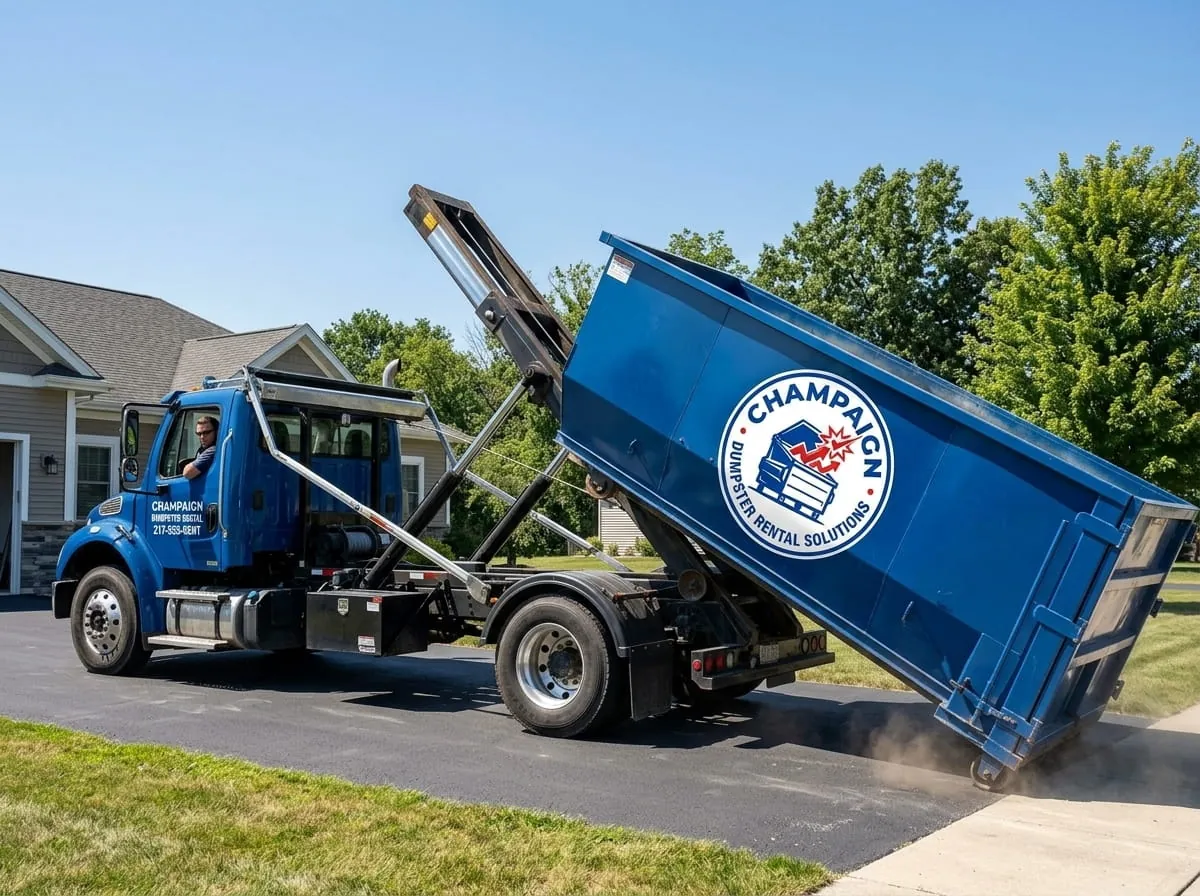
Useful numbers for judging your own frontage: a 20 yard is twenty-two feet of container and the truck needs roughly ten more feet of clear run behind it. A 15 yard takes six feet less on the ground.
Across the newer subdivisions in Savoy, Mahomet and south Champaign that is straightforward. In the older village cores of Tolono, Philo and Sidney, and the older streets of Champaign and Urbana, it is sometimes genuinely not — and a 15 yard with a swap is the workable shape.
Street placement: ask before you plan
Rules for containers in the roadway are set by each municipality individually, and we would rather you asked than assumed.
Our advice is always to get it onto private property where possible, and here there are two good reasons beyond the paperwork. Snow — a container in the street through an Illinois winter is in the way of a plow, and that is a problem for everyone on the block. And drainage — anything obstructing a gutter or storm inlet causes problems well beyond the container, particularly in a county this flat where water does not run away quickly.
⚠️ Seventeen municipalities, four counties
Worth being precise about, because it decides more than placement.
- Champaign City ordinances — the hauler licensing, the required weekly subscription, the mandated free recycling, the seasonal yard waste collection and the burning prohibition — apply inside the Champaign city limits. Nowhere else.
- ⚠️ Urbana is a separate city and handles waste differently. The twin cities share a built-up area, a university and a street grid. They do not share arrangements, and the boundary is not obvious on the ground. This is the most common mix-up in the county.
- Illinois municipalities are cities, villages and incorporated towns, plus townships. Twelve of our seventeen service areas are villages — Savoy, Mahomet, Rantoul, St. Joseph, Tolono, Philo, Sidney, Ogden, Fisher, Thomasboro, Homer and Pesotum. Urbana, Monticello, Paxton, Gibson City and Tuscola are cities.
- Rantoul is a village despite having around twelve thousand residents. Illinois villages are not necessarily small, and the classification says nothing about population.
- Four counties — Champaign, plus Piatt (Monticello), Ford (Paxton, Gibson City) and Douglas (Tuscola). County-level answers differ accordingly.
⚠️ And the burning prohibition specifically reaches 1,000 feet beyond the Champaign and Urbana boundaries, so it covers properties that are not in either city — the detail is here.
⚠️ The campus edge
The tightest working environment in this county, and the one place where placement genuinely needs thinking about in advance.
- Street parking is contested and often metered or permit-controlled. A container occupying spaces may need permission from the relevant city — and remember that could be Champaign or Urbana.
- Alley access is common and frequently the best answer, but alleys are narrow and one badly parked car blocks the whole run.
- Driveways near campus are short, often shared, and sometimes serve several units.
- Overhead wires and mature street trees. We need roughly twenty-two feet of clear height to raise the bed, and on a job with a mid-course swap it has to work twice.
- In May and August, book the placement conversation weeks ahead, not days — see the turnover guide.
The permits that actually matter
The container is rarely the regulated thing. These are:
- Building permits for the underlying work
- Demolition permits, usually separate, and often carrying asbestos conditions
- Utility locates. Call 811 before any excavation — free, required, not optional
And one specific to this city: a roll-off company is a commercial hauler under the Champaign ordinance and needs a City hauler license, renewed annually. That is ours to hold, not yours, but it is a fair question to ask anyone quoting you.
Protecting a driveway
Boards go under the rails on every single delivery, without being asked and without a charge.
- Point loading is the risk, not total weight. The rails and wheels concentrate several tons into small contact patches.
- Freeze-thaw has already worked on your driveway. Water gets into a crack, freezes, expands and widens it, every winter. An already-cracked slab is more fragile than it looks, and frost depth here is real.
- New concrete needs to cure properly before it takes a loaded container. If you have just had it poured, say so.
- Freshly sealed asphalt needs to cure too. Tell us and we will find another spot or another date.
- Point us at the strongest part of the drive. You know where it cracks and we do not.
What we need from you
- Whether the container is going on private property or the street
- The full address — which city or village, and which county
- ⚠️ Whether you are in Champaign or Urbana, if you are anywhere near the boundary
- Whether there is a landlord or an association, and whether you have asked them
- Your driveway length, width, surface and age
- Any branches, wires or low overhang near the placement
- Whether the underlying work is permitted
- In winter, where the snow has been pushed — and please clear the placement area
We cannot pull street permission for you — it attaches to the property owner or the contractor — but we work across all of these municipalities and can make sure you ask the right office first time.
Ordinances vary by municipality and change over time, and this service area covers four counties. Everything above reflects how these jurisdictions generally operate at the time of writing, and the Champaign points apply inside the city limits. For anything consequential, confirm with your own city or village hall.
Need a container in Champaign?
Call and describe the job. Three minutes on the phone gets you a size recommendation, a flat rate and a delivery window — and we will tell you if a smaller, cheaper container is the right answer.
Call (217) 207-3185